

Creating Cases
A user can choose to create a case from scratch or from a previous successful run.From Scratch
1
Open the test detail view
Navigate to the test where you want to add a case and click Add case.
2
Set a name
Give the case a descriptive label (e.g., “Short product description”, “Edge case: empty input”).
3
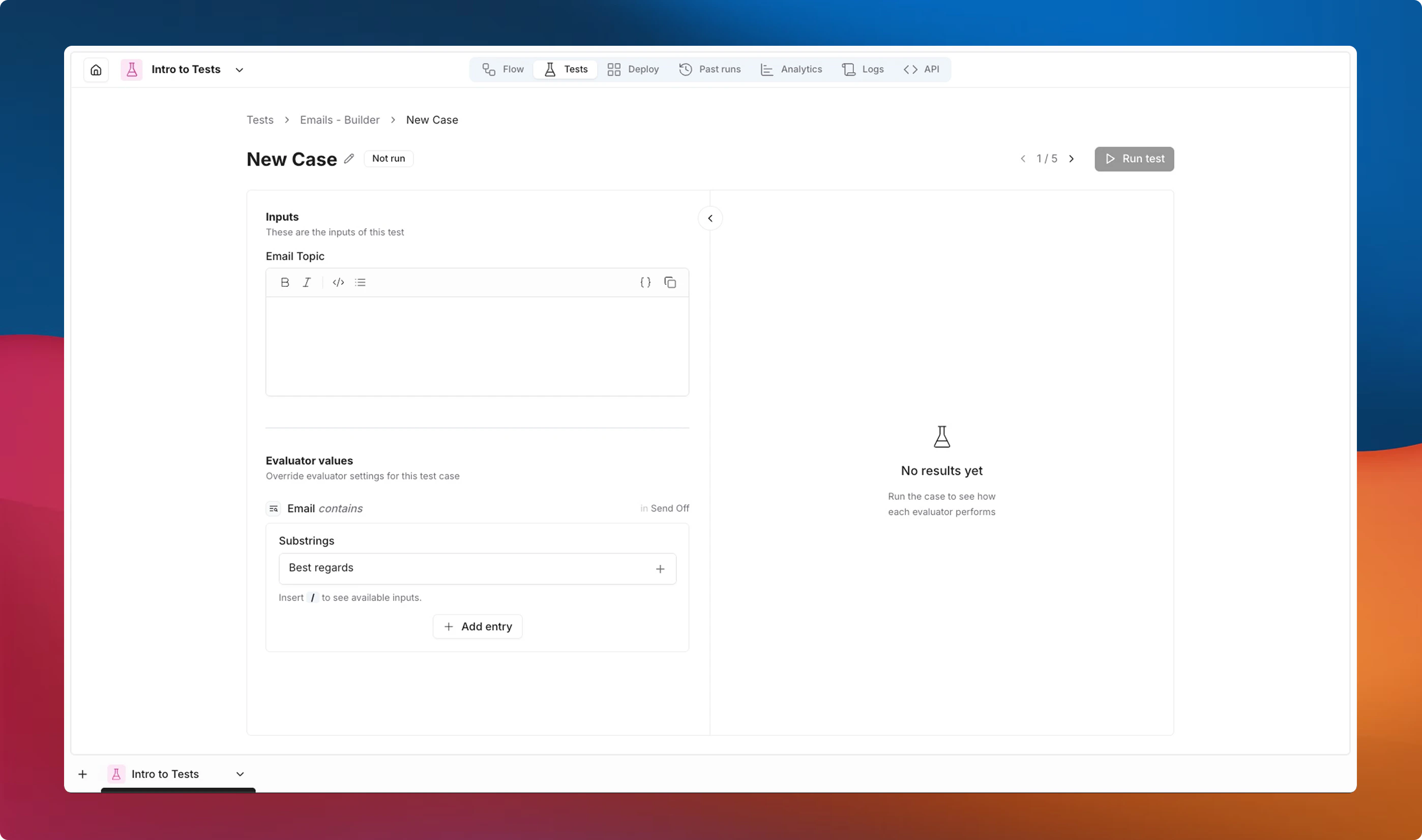
Fill in the inputs
Provide values for each of the flow’s input connectors. The form automatically shows the input fields defined in your flow.
4
Set evaluator values
Provide the values needed for each evaluator to perform its check. They may come with a default set on the evaluator, but can be overridden per case to match the expected result for that specific scenario. See Per-Case Overrides for details.
From a Previous Run
1
Open the past runs
Navigate to the Past runs tab of your flow.
2
Create a case from a run
Find a completed run that represents a good test scenario and click the icon on that row. This will pre-fill the case inputs with the values used in that run.
3
Select a test and review
Choose which test to add the case to, or create a new one, and save.
You can also reach the Past runs from inside a test — click the dropdown next to Add case and select Import from runs.
Managing Inputs
Test case inputs map directly to your flow’s input connectors. When your flow has multiple inputs (e.g., a text input and a file input), each one appears as a separate field in the case editor.Inputs marked as not visible when running (fixed inputs with the “Visible when running” toggle disabled) are automatically hidden from the case editor. The flow uses their fixed value during execution — you do not need to provide them. If a fixed input is still visible when running, its value is pre-filled but can be overridden per case.
Evaluator Overrides
Some evaluators have properties that can be overridden per case. The value you set on the evaluator acts as the default, but you can customize it for individual cases without creating a separate evaluator. Overridable properties appear in the Evaluator overrides section at the bottom of the case editor. Only properties marked as overridable on the evaluator are shown — see the Evaluators page for which properties support this.Bulk Operations
You can select multiple cases using the checkboxes in the cases table to perform bulk actions:- Run selected — execute evaluations only for the selected cases.
- Delete selected — remove multiple cases at once.
Running Cases
You can run cases in several ways:- Run all — from the test detail view, click Run all to execute every case in the test at once.
- Run from the table — click the button on a specific case row to run just that case.
- Run from inside a case — open a case and click Run to execute it individually and see the results in real time.
- Run a selection — select multiple cases using the checkboxes and use the Run bulk action.
You must have at least one evaluator configured in the test before you can run any cases. The run buttons will be disabled until an evaluator is added.